Quick Summary:
In South Africa, registering your spaza shop needs approval from the local municipality and, for some businesses, from the CIPC too. Running your spaza shop without legal registration can put you in trouble with authorities. This guide details the full spaza shop registration process, the documents and authorities involved, costs, and ongoing compliance.
This article will help you understand:
- Why running an unregistered spaza shop is a legal risk
- How to register your spaza shop step by step
- How to get approvals from the municipality and the CIPC
- Documents, authorities, and costs involved in spaza shop registration
Spaza shops sell to millions of South Africans every day. These outlets are go-to shops for daily needs, from bread, milk, and snacks to airtime and groceries. If you are interested in registering your existing spaza shop or a new one, you need to know the exact process, documentation, approval authorities, and compliance required for easy and hassle-free registration. If you know the process of registering a spaza shop, then you are already prepared with the documents and key requirements.
This guide helps you understand the process of registering your spaza shop and also details how you need to prepare for post-registration VAT and SARS compliance with a POS system for spaza shops.
Spaza Shop Registration is Mandatory in South Africa
A spaza shop is a small convenience store run from homes, corner shops, containers, and even commercial structures in township areas. Spaza shops run in both rural areas and townships. These shops sell everyday essentials, basic groceries, airtime, electricity, milk, etc., to customers who mostly live nearby (walking distance). Modern Spaza shops in townships now use software to handle their inventory, billing, CRM, and everyday operations.
For decades, spaza shops operated without registration requirements. Anyone could open a spaza shop in their home or yard. However, after many instances of foodborne diseases linked to unhygienic practices at spaza shops, the government made registration compulsory. Anyone running a spaza shop was formally required to obtain registration by 17th December 2024. This was later extended to 28 February 2025.
Today, a spaza shop is treated much like any other food-handling or general dealer business once it starts trading. That means a municipal trading permit is compulsory. Many spaza shop owners also get business registration with the Companies and Intellectual Property Commission (CIPC).
Intresting Fact Traditional trade, spaza shops and independent traders generated R43.1 billion in sales in the first quarter of 2026 alone.
Source:NIQ South Africa, 2026.
South Africa’s township economy is now estimated at close to R900 billion. With such a whopping contribution to South Africa’s economy, the formalisation and registration of spaza shops become a necessity.
Difference Between a Registered and an Unregistered Spaza Shop
A registered spaza shop can work without fear of authorities and focus on growth. Any unregistered shop faces risks of immediate shutdown and stock seizure by authorities.
The Key Differences Between a Registered and Unregistered Spaza Shop.
| Factors | Unregistered | Registered |
|---|---|---|
|
Legal status |
Not recognised by the municipality and cannot trade legally |
Recognised and can trade legally |
|
Trading permit |
None displayed |
Municipal permit displayed in-store |
|
Business bank account |
Difficult to open |
Ready using registration documents |
|
Supplier terms |
Cash-only, no trade with registered retailers |
Can trade on credit terms, bank-to-bank transfers, and with registered retailers and wholesalers |
|
Access to funding |
Not eligible |
Eligible for the Spaza Shop Support Fund and similar schemes |
|
Tax status |
Untracked income, SARS risk |
No SARS risk with VAT-compliant billing |
|
Food safety compliance |
No Certificate of Acceptability |
Certificate of Acceptability, which is mandatory for spaza shops selling food items |
|
Risk exposure |
Fines, stock seizure, forced closure |
Legally protected trading status |
Why Not Registering Your Spaza Shop is a Mistake
- The government has told communities not to buy from spaza shops that don’t display a valid registration certificate and permit.
- Authorities have already shut down hundreds of non-compliant spaza shops nationally, and selling food without a valid Certificate of Acceptability can carry fines and imprisonment of six to twenty-four months.
- Beyond the legal risk, an unregistered spaza shop simply can’t do certain things. It can’t open a proper business bank account. It can’t apply for a small business loan.
- An unregistered spaza shop is not eligible to access government relief funds built specifically for spaza owners.
Therefore, registering your spaza shop is the first step you should take if you want to scale your business without hassles.
Step-by-Step Process of Registering a Spaza Shop in South Africa
Registering a spaza shop with the municipality is mandatory. You need to obtain the license and permit to run the spaza shop from your municipality.
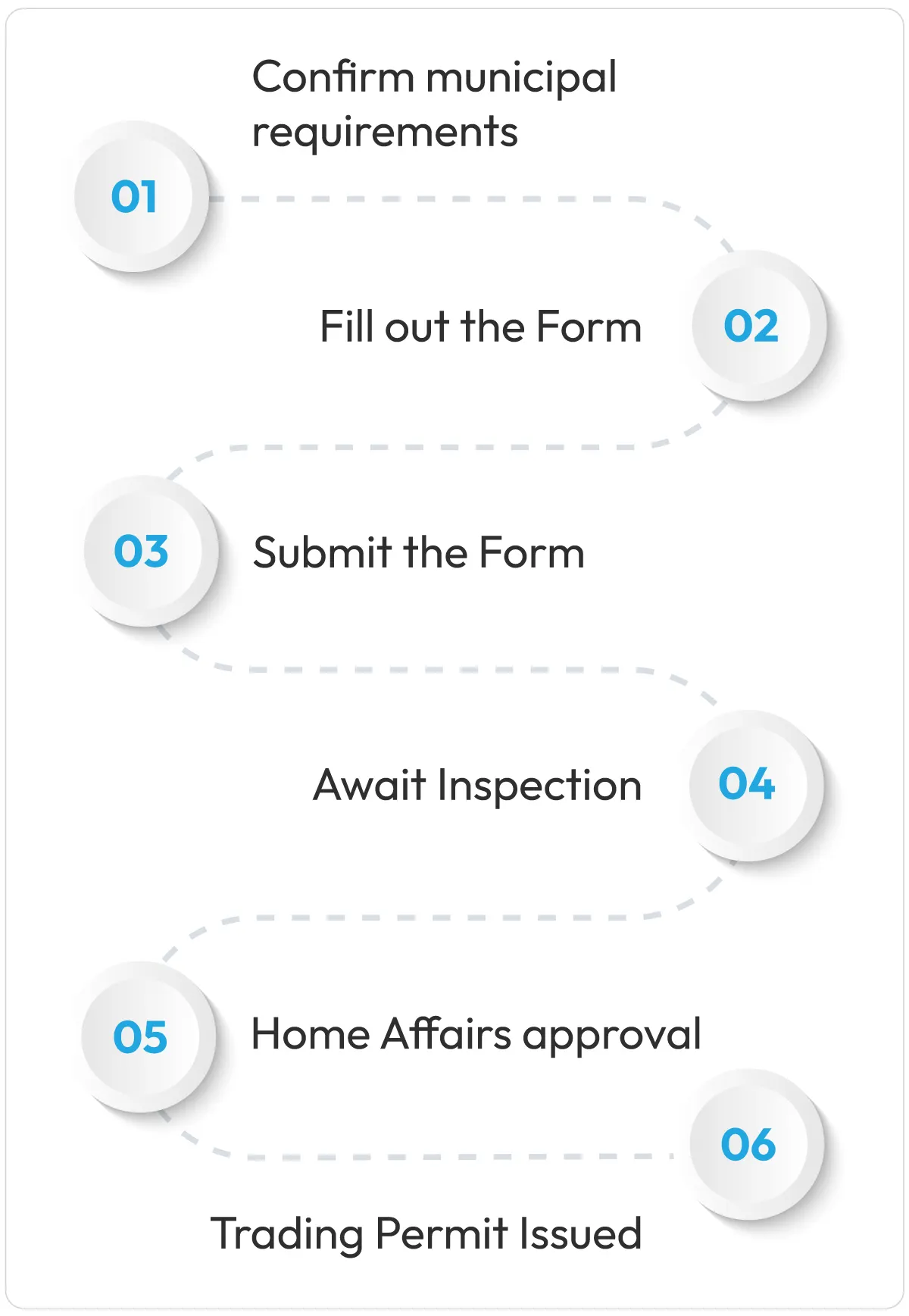
Requirements can differ slightly between municipalities, but the process generally follows these steps:
Step 1: Confirm Your Municipality’s Exact Requirements
Visit your local municipal office or check its website, since document lists and fees vary by area, localities, and municipalities in South Africa.
Step 2: Fill Out the Form
Get and complete the trading permit application form, available at the municipal office or online. Attach the documents as required in the application form. View: Sample Registration Form.
Step 3: Submit the Form
Submit the form with your documents at the municipal office, or online where your municipality offers this.
Step 4: Await Inspection
Once your application is submitted, your local municipality officials will visit the spaza shop to check for zoning rules and on-site compliance. Keep your premises clean.
Step 5: Approval by the Department of Home Affairs
For registration, the applicant’s legal status is also important. This approval comes from the Department of Home Affairs.
Step 6: Trading Permit Issued
After approval from the Department of Home Affairs, you will receive the registration document, which you need to display in your spaza shop.
Note:
- If you sell food, a Certificate of Acceptability from the Environmental Health Department is also mandatory. The Certificate of Acceptability is often the slowest part of the process. It can take three to six months to be issued, so if you sell any food at all, start that application as early as possible.
- If you need higher benefits like business loans, funding, access to retail and wholesale business networks in South Africa, then you need to obtain CIPC registration also.
- You’ll need to apply for VAT once your turnover approaches or exceeds R1 million in any 12 months.
Documents Required for Spaza Shop Registration
Exact requirements vary by municipality, so always confirm with your local office. In general, you’ll need the following.
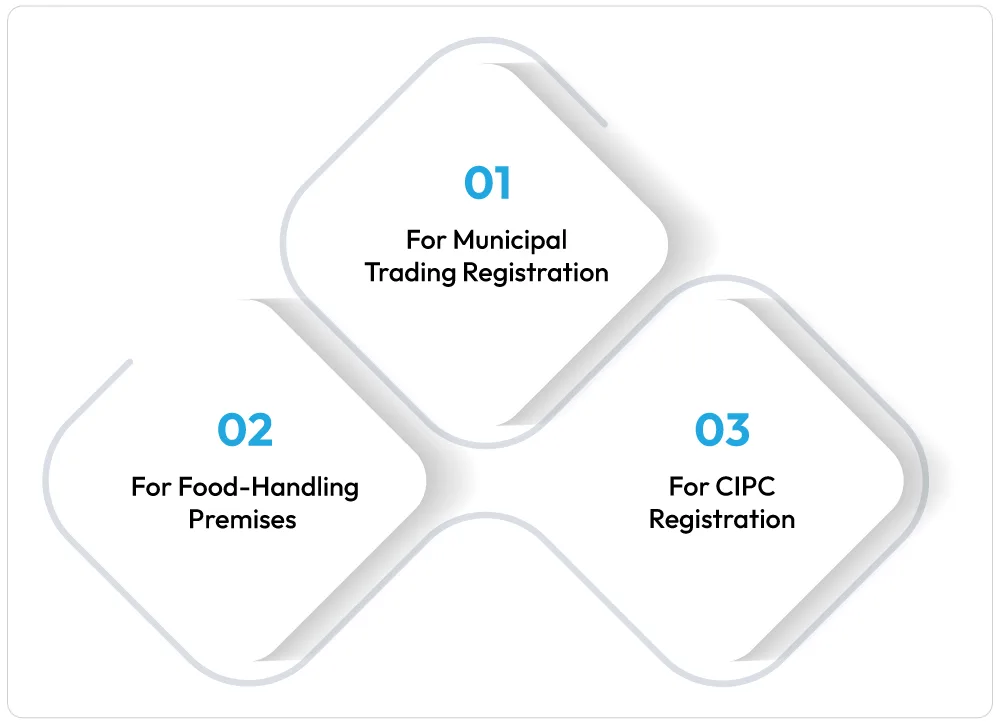
1. For Municipal Trading Registration
- Certified copy of your South African ID, or passport and visa or permit for foreign nationals.
- Proof of address for the shop, such as a municipal account, rental agreement, or an affidavit confirming the location.
- A copy of the title deed if you own the premises, or a lease agreement plus the landlord’s certified ID and an affidavit if you rent.
- A zoning certificate or special consent approval, where your municipality requires one.
- A signed and stamped affidavit confirming you’re not trading in illegal goods.
- A banking confirmation letter for your personal or business account.
- A SARS Tax Compliance Status confirmation.
- A completed application form for your specific municipality.
2. For Food-Handling Premises (Certificate of Acceptability)
- All of the documents above.
- Proof of waste removal services, such as a municipal account or a private contractor’s invoice.
- A pest control service contract and a recent treatment report.
- Details of the goods sold and food-handling practices at the shop.
3. For CIPC Registration:
If you go for CIPC registration along with your municipal registration of a spaza shop, then the following documents are also required:
- A certified copy of your ID or passport.
- A valid email address and cellphone number for every director.
- One to four proposed business names, in order of preference, if you want a reserved name rather than a CIPC-generated enterprise number. Decide on your trading name, and check its availability on the CIPC name search tool.
- Proof of address for the business.
Pre-Process Checklist
Before you visit your municipal office, work through this checklist:
- Check the zoning of your premises, and whether you need a zoning certificate or special consent.
- Have your South African ID, or passport and visa, ready and certified.
- Make certified copies of every document before you submit anything.
- Confirm you have a South African bank account, or open one, in your name or your business’s name.
- If you sell any food, start your Certificate of Acceptability application immediately, given the long processing time.
- Keep a folder of receipts and reference numbers for every application you submit.
Authorities Involved in Spaza Shop Registration (Including CIPC)
The below authorities are involved in the spaza shop registration process:
1. Local Municipality: Issues the trading permit or licence and enforces zoning and by-laws.
2. Environmental Health Department: Inspects food-handling premises and issues the Certificate of Acceptability.
3. Department of Home Affairs: Issues business visas and permits for foreign national applicants.
4. CIPC: Companies and Intellectual Property Commission registers your business as a formal legal entity.
5. SARS: South African Revenue Service Issues your tax reference number and Tax Compliance Status, and handles VAT registration.
6. Municipal enforcement teams: They carry out compliance checks and close shops trading without valid permits.
Cost of Spaza Shop Registration
Spaza Shop registration is designed to be affordable to promote the informal economy into formal organized business. It is therefore advised to get the registration done. Seizure of goods, shop shutdowns by the municipal enforcement team or South African police, and penalties can be very costly.
While the costs of registration vary by municipality, the table below details the estimated costs.
| Registration Item | Estimated Cost |
|---|---|
|
Municipal trading permit or licence |
Roughly R200 – R1,000, depending on the municipality |
|
Certificate of Acceptability application |
Varies by municipality; check with your Environmental Health Department |
|
Free |
|
|
Optional professional or agent-assisted registration |
Roughly R590 – R950 |
|
CIPC registration without a reserved name |
R125 |
|
CIPC registration with a reserved name (R125 + R50 name reservation) |
R175 |
Recent Developments in Spaza Shop Regulation (2026)
Spaza shop regulation is still moving, and a few 2026 developments are worth knowing if you’re registering now.
The Government Recently Conducted a Fresh Registration and Funding Drive
The Department of Small Business Development, working with SEDFA and the National Empowerment Fund, launched a fresh nationwide outreach campaign from June 2026 to help more spaza shop owners meet compliance requirements and access the R500 million Spaza Shop Support Fund. By early June 2026, the fund had received 4,522 complete applications nationally (SAnews).
R179.6 million has already been approved
Despite compliance challenges among applicants, the government approved R179.6 million in Spaza Shop Support Fund payouts across all nine provinces by the end of May 2026, split between SEDFA-approved and National Empowerment Fund-approved enterprises (SAnews).
Post-Registration Compliance Requirements
Registration gives your spaza shop legal status to start without issues from municipal authorities. However, there are some ongoing compliance requirements that you need to follow.
- You need to keep a record of expenses for your spaza shop to bring the tax liability down. Keep a record of all purchases for your spaza shop. Include electricity bills, rent, purchase receipts, etc.
- Bill your customers digitally using a POS system so that you keep a record of sales.
- Keep your premises dry, and do regular infestation treatment to avoid inspection-related penalties.
- Keep track of expired items and get rid of them. Selling expired items will put you in trouble.
- If your revenue exceeds R1 million in any 12 months, you need to get VAT registration.
- If you sell food items and have obtained the Certificate of Acceptability, you need to make sure the hygiene requirements are adhered otherwise, the municipal authorities can withdraw the license.
- Keep your accounting done the right way. Use accounting software for a spaza shop for the same.
Wrapping Up
Registering a spaza shop in South Africa protects the business you’ve already built and opens doors that stay closed to unregistered shops. Registration safeguards you from municipal actions such as forced closure of your unregistered spaza shop, penalties, and stock seizures.
Once you’re registered, the next step is making sure your day-to-day billing keeps up with your new tax obligations. A SARS-ready POS system manages that for you, along with your inventory, accounting, and customer management needs.
Vasy’s POS software for South African retailers is built with VAT-compliant billing, an inventory management module, and SARS tax compliance, so every sale generates a proper tax invoice without extra admin. Paired with Vasy’s accounting software, your VAT and tax records stay accurate and audit-ready, which matters far more once your business is registered and being tracked.
Frequently Asked Questions Regarding Spaza Shop Registration
Municipal trading permit registration is generally processed within a few weeks if your documents are complete and have no issues. However, registration timelines generally differ by municipality.
Municipal trading registration is compulsory for every spaza shop. CIPC registration isn't always legally required for a sole trader, but it's strongly recommended. Most big box retailers, suppliers, and wholesalers provide the line of credit and goods to CIPC-registered shops only.
An unregistered spaza shop risks fines, stock confiscation, and immediate closure without notice. For food-handling premises, trading without a Certificate of Acceptability can carry imprisonment of six to twenty-four months. The government has also told communities not to buy from shops without a displayed permit.
Yes. In fact, VAT registration is compulsory once your taxable turnover exceeds R1 million in 12 months. However, you can register voluntarily below that threshold.
Yes. Foreign national applicants need a valid passport, asylum seeker permit, or refugee permit, along with a valid business visa authorising them to trade in South Africa. Their trading permit remains linked to the validity of that visa or permit.
POS software with modules for stock verification, inventory management, expiry management, accounting, barcode-based billing, and VAT compliance is key to keeping your spaza shop ready for municipal inspections and SARS tax audits.
Last Updated on September 25, 2026