Quick Summary:
South African warehouses struggle with limited space, stock theft, misplaced stock, spoilage, and growing online order volumes. Manual warehouse management can multiply the problems. Therefore, warehouse management best practices must be implemented to design the layout, store goods, and manage and dispatch inventory.
This article will help you understand:
- What warehouse management best practices are and why they matter.
- 12 warehouse management tips you can start using this month.
- Common mistakes that hurt efficiency.
- How technology improves stock accuracy and speed.
Warehouses have to deal with extensive challenges. From designing the layout to store goods for better space utilisation to keeping track of every stock moving in and out of the warehouse, warehouse management is not easy. Missing stock, misplaced pallets, or expired batches can cause huge losses. Without proper management and tracking of goods within the warehouse, you are always at risk of delays in dispatch and order fulfilment.
Therefore, you need to know the best practices of warehouse management to run your warehouse efficiently and prevent the issues that most warehouse managers face.
This guide details the top 12 warehouse management best practices to manage your warehouses without hassle. The article also highlights how an efficient warehouse management system can help bring operational excellence in warehouses.
What are Warehouse Management Best Practices and Why Do They Matter?
Warehouse management best practices are standard operating procedures, tips, proven ways, methods, frameworks, and to-dos that help you run your warehouses in the most efficient, profitable, and sustainable way. From how your stock arrives in the warehouse to where it is stored, how it is labelled and barcoded, and which stock goes in/out first, everything is done in a smart way when you are following the best practices of warehouse management.
Why do they matter?
- A wrong stock location wastes minutes in finding it.
- A wrong layout can consume more space.
- A poorly placed batch can get spoiled.
- A misplaced pallet delays the order.
- A wrongly labeled batch can take hours to find and rectify.
- A wrong stock count causes a stockout.
- A late dispatch loses a customer.
Over the years, these errors cause huge losses, mismanagement, staff burden, and poor customer experiences due to delayed orders. Your whole supply chain gets affected.
This is why the best warehouse management practices are key to efficient and flawless warehouse management. Warehouse management tips standardise the process, record every stock movement, and help eliminate the chaos in the warehouse.
For a deeper look at the record-keeping side, read our guide to inventory management for South African businesses.
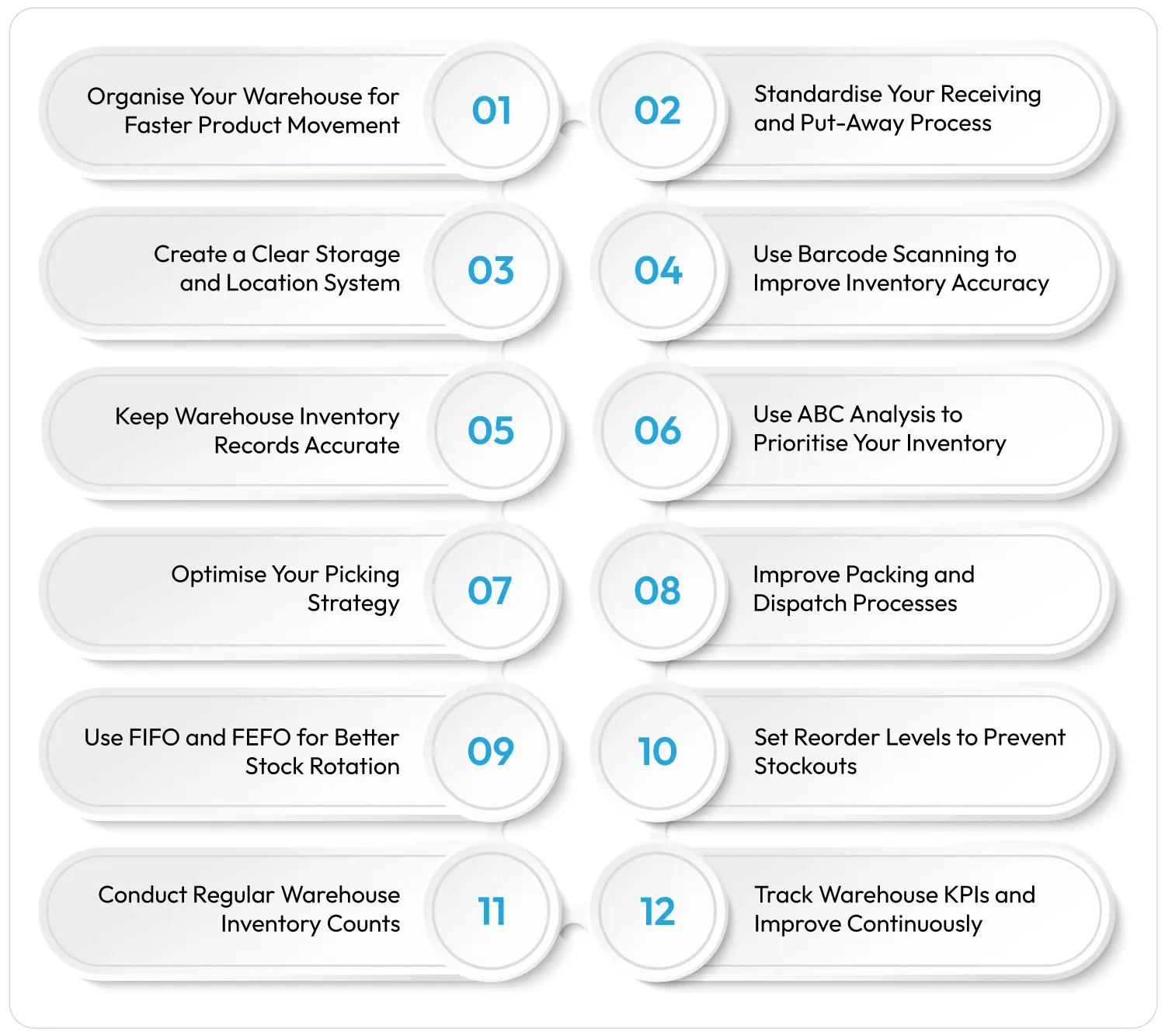
12 Warehouse Management Best Practices to Improve Your Operations
Each of these warehouse management best practices starts with a pain point. Then it gives you the fix.
1. Organise Your Warehouse for Faster Product Movement
The problem: Inventory stored in the wrong location. Warehouse staff have to walk long distances to fetch the inventory. Fast-moving items are stored at the back.
The solution: Design the layout for storing goods after analysis of the stock demand. Fast-moving goods should be located near the dispatch or packaging area.
- Place fast-moving SKUs close to the packaging and dispatch area.
- Keep aisles wide enough for your equipment to move easily without getting obstructed.
- Create separate zones for returns, damaged goods, and quarantined stock.
- Keep heavy items on lower racks for safety.
2. Standardise Your Receiving and Put-Away Process
The problem: No proper receiving mechanism, and goods are put away just based on where the space is empty.
The solution: Create a proper SOP for receiving and put-away.
- Check the delivery against the purchase order.
- Count the goods received for damage, spoilage, and labels before you take them in.
- Record their condition and label them.
- Use ASNs (advanced shipping notices) to clear spaces for expected goods.
- Put them away in the assigned location/bin.
3. Create a Clear Storage and Location System
The problem: Only the manager, a supervisor, or one particular employee knows where a batch is stored. Inventory information that rests with particular staff members cannot be useful if the person is unavailable on the dispatch day.
The solution: Give every staff member in the warehouse the same information with a standard record of the goods’ position in the warehouse available in the inventory management system. The records must show the zone, aisle, rack, shelf, and the bin in which the goods are stored.
- Assign each SKU a detailed storage location.
- Label racks, shelves, and bins clearly.
- Link overflow stock to a reserve location.
- Update the location in your system whenever stock moves.
- Go for bin-level recording and tracking.
4. Use Barcode Scanning to Improve Inventory Accuracy
The problem: Manually tracking stock in the warehouses and reading labels to know stock types.
The solution: Set up a barcode system and scan the labels with a barcode scanner or mobile-based barcode scanning app to see the complete information on the label on your device. Each scan confirms the item, the quantity, and the location.
Did you Know? Barcodes are so mainstream that 81.2% of warehouse inventory operators use barcode scanning.
Source:Inflowinventory
5. Keep Warehouse Inventory Records Accurate
The problem: Stock moves without being recorded. A batch of goods is put in storage but not recorded. Cartons and pallets are recorded by hand, so errors creep in.
The solution: Record every movement on the day it happens. No manual records or verbal transfers.
- Record everything digitally for an audit trail
- Use codes for various operational activities.
- If stock is received, dispatched, returned, or gets damaged, records are necessary.
- Proper records reduce stock losses.
6. Use ABC Analysis to Prioritise Your Inventory
The problem: Treating a R10 item and a R10,000 item the same wastes time and money.
The solution: Rank your SKUs by annual value or usage. Then divide them into three groups using the Pareto analysis method.
- A items: Few SKUs take the biggest share of value. These have to be prioritised with frequent counts.
- B items: They create moderate value and therefore a fixed review is important.
- C items: Many SKUs but small in value. You can do their stock count at longer intervals.
Use these classes to decide:
- Count frequency
- Slotting
- Safety stocking.
- Space utilisation
- Priority
7. Optimise Your Picking Strategy
The problem: Picking is often the most labour-intensive task in the warehouse. Workers move in a zigzag between overcrowded aisles. Orders get delayed and sometimes mixed up.
The solution: Check your inventory records to know the exact location of the items.
- Organise the aisle for better reach.
- Allot pickers to each aisle. This way, the same pickers go to a particular aisle.
- Implement any of the picking strategies: discrete, batch, zone, or wave picking.
- Send the picker along with a barcode scanning device for faster identification of the stock, batches, or pallets.
- Smart order management works by matching the picking method to your orders.
8. Improve Packing and Dispatch Processes
The problem: Orders leave with missing items, wrong labels, or oversized cartons that inflate dispatch and transport costs.
The solution:
- Set up a packaging space with packaging materials, labels, and a scanner.
- Scan each item into the carton to verify the order.
- Choose carton sizes that fit the goods. Less empty space means lower freight space.
- Keep proof-of-dispatch records.
9. Use FIFO and FEFO for Better Stock Rotation
The problem: Old stock is stored at the back while new stock is sold first. Products expire or become obsolete.
The solution: Use the right rotation rule for each product.
- FIFO (First In, First Out): the oldest stock ships first. Best for general goods.
- FEFO (First Expired, First Out): the earliest expiry date ships first, regardless of delivery date. Best for food, beverages, cosmetics, chemicals, and medicines.
- Record batch numbers and expiry dates at receiving in the inventory management module’s expiry feature.
- Set near-expiry alerts too.
10. Set Reorder Levels to Prevent Stockouts
The problem: Stockouts lose sales while overstocking in the warehouse ties up space.
The solution: Set a reorder level for every SKU.
Reorder level = (average daily sales x supplier lead time) + safety stock
Example: If you sell 80 cartons a day. Your supplier takes 5 days to deliver. Your safety stock is 120 cartons. Your reorder level is (80 × 5) + 120 = 520 cartons. When stock hits 520, raise a purchase order automatically. This way, your warehouse inventory can sufficiently manage orders without stockout issues.
Also take note of supplier reliability. If suppliers delay the reorders, it causes delays in order fulfilment even if you have some buffer stock. Use a smart inventory management system that lets you map suppliers with specific goods. You can map products to their best suppliers based on punctuality, quality, and price.
11. Conduct Regular Warehouse Inventory Counts
The problem: The annual stock count reveals huge discrepancies between recorded and physical stocks. You have limited knowledge of where the stock is missing, how much was spoiled, expired, stolen, or misplaced. With only annual stock counts, you are finding errors months later.
The solution: Consider cycle counting inventory. Cycle counting means counting a few batches every day or week until all stock is counted. This lowers the burden and divides the huge task into smaller and easily manageable stock counts. You can also follow other cycle counting methods such as:
- Count A items weekly, B items monthly, and C items quarterly or half-yearly.
- Do blind counts. The counter should not see the system quantity.
- Recount before adjusting the system.
- Use a mobile-based scanning and stock verification app to speed up counts.
12. Track Warehouse KPIs and Improve Continuously
The problem: You cannot fix what you do not measure.
The solution: Track KPIs every week.
- Inventory accuracy (%)
- Order accuracy or perfect order rate
- Dock-to-stock time
- Pick rate (order lines per hour)
- Stockout rate
- Space utilisation
- Shrinkage (%)
- Cost per order
Common Warehouse Management Mistakes That Reduce Efficiency
Common mistakes and oversights that reduce warehouse efficiency and cause resource loss. If you follow warehouse management best practices, these mistakes get reduced automatically.
- Running on spreadsheets and paper.
- No fixed storage locations and storing goods as per available space.
- Waiting for the annual stock count.
- Not tracking expiry of goods.
- Relying on a few staff members only.
- Not making SOPs for all warehouse staff.
- Reordering without demand forecast tracking.
Warehouse Management Best Practices for Different Business Types
| Business Type | Best Practices |
|---|---|
|
Warehouse Management for Retail Businesses |
|
|
Warehouse Inventory Management for Wholesale and Distribution |
|
|
Warehouse Management for Manufacturing Businesses |
|
|
Warehouse Best Practices for FMCG and Perishable Products |
|
|
Warehouse Management for Multi-Location Businesses |
|
How Can Technology Improve Warehouse Management?
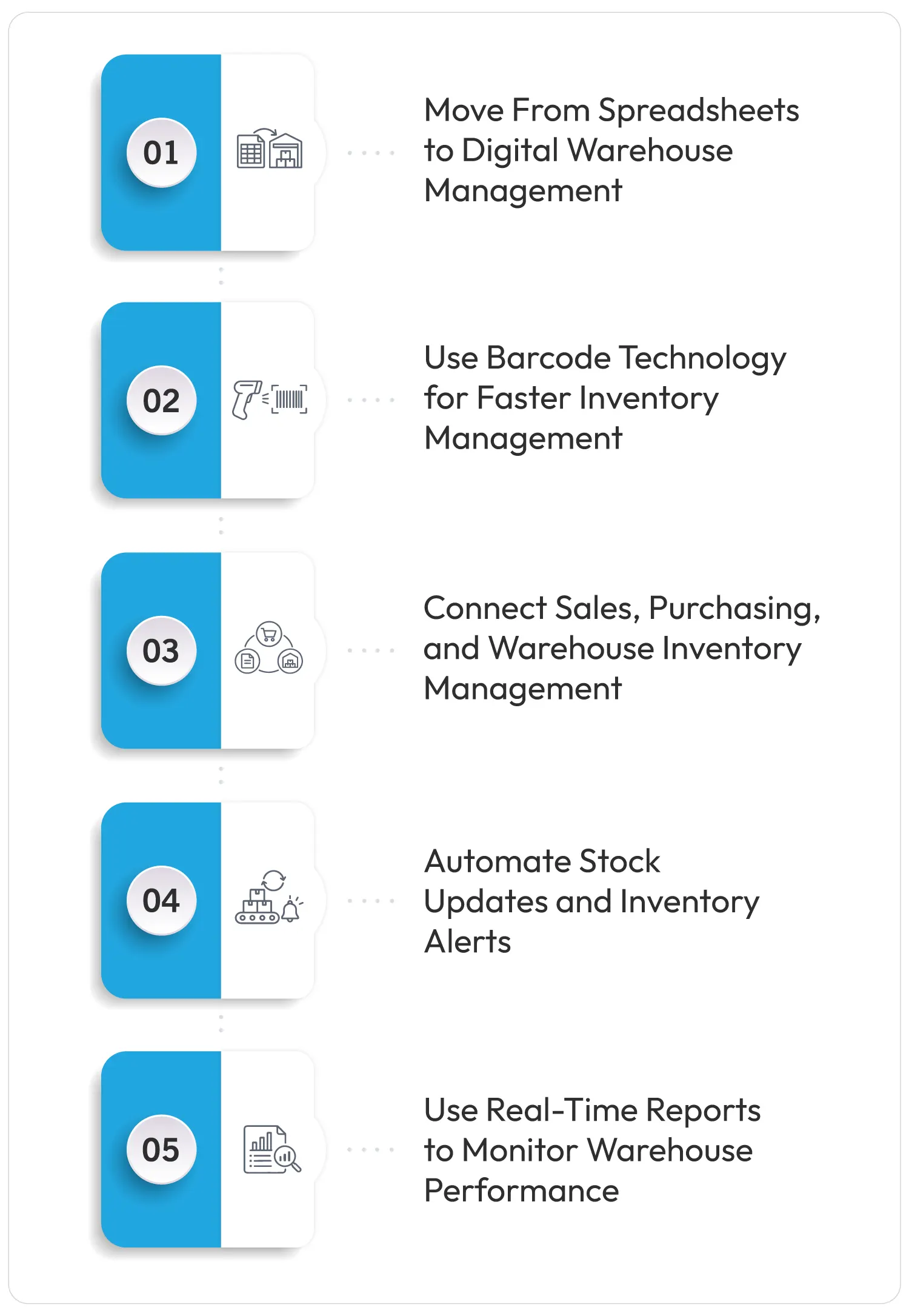
The technology below transforms warehouse management best practices into automatic routines. If you want to improve warehouse efficiency at scale, technology is the next step.
Warehouse management best practices need set procedures, SOPs, and automation of various activities. Warehouse management software with connected modules for POS, inventory, accounting, and e-commerce is what you need.
The best warehouse management software in South Africa, such as Vasy, comes with the following features to improve warehouse efficiency.
Move From Spreadsheets to Digital Warehouse Management
Spreadsheets are familiar, but they are prone to issues like human errors and data duplication, and have limited features. You do not get expiry alerts from spreadsheets. Therefore, move from spreadsheets to digital warehouse inventory management systems.
Use Barcode Technology for Faster Inventory Management
Handheld scanners or mobile phones can read labels in seconds. Barcode generators in POS systems can create barcodes for SKUs, batches, and bin locations. Barcoding is a smart technology to track stock movement inside the warehouse.
Connect Sales, Purchasing, and Warehouse Inventory Management
Disconnected systems create warehouse management issues. If you know how much you sell from the POS data, you know how much inventory you need to buy for the next round of sales. This way, you also know how much inventory will come to your warehouse and how many days it will be stored before hitting the stores.
For such competencies, you need a system that connects your sales, purchases, and warehouse. You might also need a POS that connects with your online store with an omnichannel module, whose inventory is also stored in the same warehouse.
Automate Stock Updates and Inventory Alerts
Warehouse automation has moved to a more advanced level in the Industry 5.0 era. AI-based warehouse automation refines the entire warehouse workflow for higher productivity and fewer errors. changing the entire workflows of modern warehouses. For instance, automated AI-generated alerts for low stocks, reorders, and near-expiry items keep warehouse activities running without disruption.
Use Real-Time Reports to Monitor Warehouse Performance
Real-time reports on warehouse, inventory, suppliers, purchase, and warehouse staff performance provide insights to standardise warehouse operations. These reports also detail how warehouse managers can better utilise warehouse resources (equipment, space, and staff). Vasy’s AI layer, vina can directly answer your queries and read these reports for you.
Final Thoughts on Warehouse Management Best Practices
A well-run warehouse is run on SOPs that expedite workflows, reduce errors, and pave the way for smoother receiving and dispatch of goods. From labelling stock and deciding their location up to the bin level to deploying FIFO/FEFO practices for better stock rotation, a warehouse management system can fully automate your warehouse activities. With AI-led insights, you can further improve warehouse operations and eliminate current challenges.
When you are ready to automate them, explore Vasy’s inventory management software or book a free demo and see how it transforms your warehouse operations. It is a practical next step in improving warehouse efficiency.
Last Updated on September 29, 2026