Quick Summary:
Food Lover's Market is a retail giant when it comes to a supermarket chain that has fruit and vegetable stores, convenience stores, liquor stores, eateries, cafes, and other lifestyle outlets. Its expansion story is a case study in itself, providing a benchmark for other retailers to run their operations with such scalability.
This article will help you understand:
- How Food Lover’s Market has grown from a single stall to one of the largest retail chains in SA.
- How it's becoming a one-stop shopping destination for retail and lifestyle shopping.
- What other South African retailers can learn from its growth story.
Food Lover’s Market began humbly with just one store, a fruit and vegetable stall in Cape Town in 1993. It was a small private stall opened in the Access Park, Cape Town. Imbibing values of honesty, integrity, and trust, the business grew from one stall to over 120 stores by 2025. Today, it is a household name in South Africa, with stores in South Africa, Southern Africa, and Namibia.
The expansion hasn’t stopped. It is still opening new stores every year. Its brand, FreshStop, is one of the fastest-growing supermarket store chains in South Africa, running over 340 stores.
This article details how Food Lover’s Market’s expansion story is a lesson for every retail store, every small business operating in South Africa. Such operations require the combination of local sourcing and technological solutions such as POS software for retail.
From One Cape Town Store to a National Retail Network
The Food Lover’s Market’s story is no less than a fairy tale. Beginning in 1993, when two brothers, Brian and Mike Coppin, decided to open their fruit and vegetable stall, no one would have imagined the scale they would reach today.
They bought a struggling veg shop–The Carrot King and turned it into a profitable venture. What’s fascinating is that they built the shop themselves, brick by brick (literally). They started with 6 employees, and today they manage over 120+ standalone grocery stores across SA.
Stock local South African goods at a fair price.
The concept of Food Lover’s Market is a key reason for their success. “If it was growing in South Africa, we would stock it”, Brian Coppin said of those initial days when they opened their first store. (Daily Investor). The store grew from 1,000m² to a sprawling 3,000m² within a month, and within one and a half year the brothers managed to open their second and third store too.
They spent the initial 5 years selling only fresh produce, and slowly expanded to dried fruit, nuts, juice on tap, and milk on tap.
The next step was franchising, and the very first franchise store opened in Port Elizabeth in 1995, followed by East London, Durban, Bloemfontein, and Pretoria. Johannesburg got its first store in 1999.
By the onset of 2012, the business was no longer identified just by its fruit-and-veg identity. It had grown from being Fruit & Veg City to Food Lover’s Market.
Soon, non-food items became a part of the stores. In 2014, UK retailer Waitrose’s products became a part of Food Lover’s Market. The turning point for Food Lover’s Market came in 2015 when it successfully raised a R760 million investment from Actis, an emerging-market investor known for backing family-owned businesses.
Sister Brands of Food Lover’s Market:
- Food Lover’s Eatery
- FreshStop
- FVC International
- Seattle Coffee Company
- Diamond’s Discount Liquor
- Market Liquors
Currently, the group is opening new outlets and revamping older ones to improve shopping experiences.
From a single store to a regional retail powerhouse, Food Lover’s Market now operates its stores across 120+ locations in South Africa. The group employs 17,000+ people and includes household brands like FreshStop, Seattle Coffee Company, Market Liquors, and VetsMart.
Why is Food Lover’s Market Investing in Bigger Retail Formats?
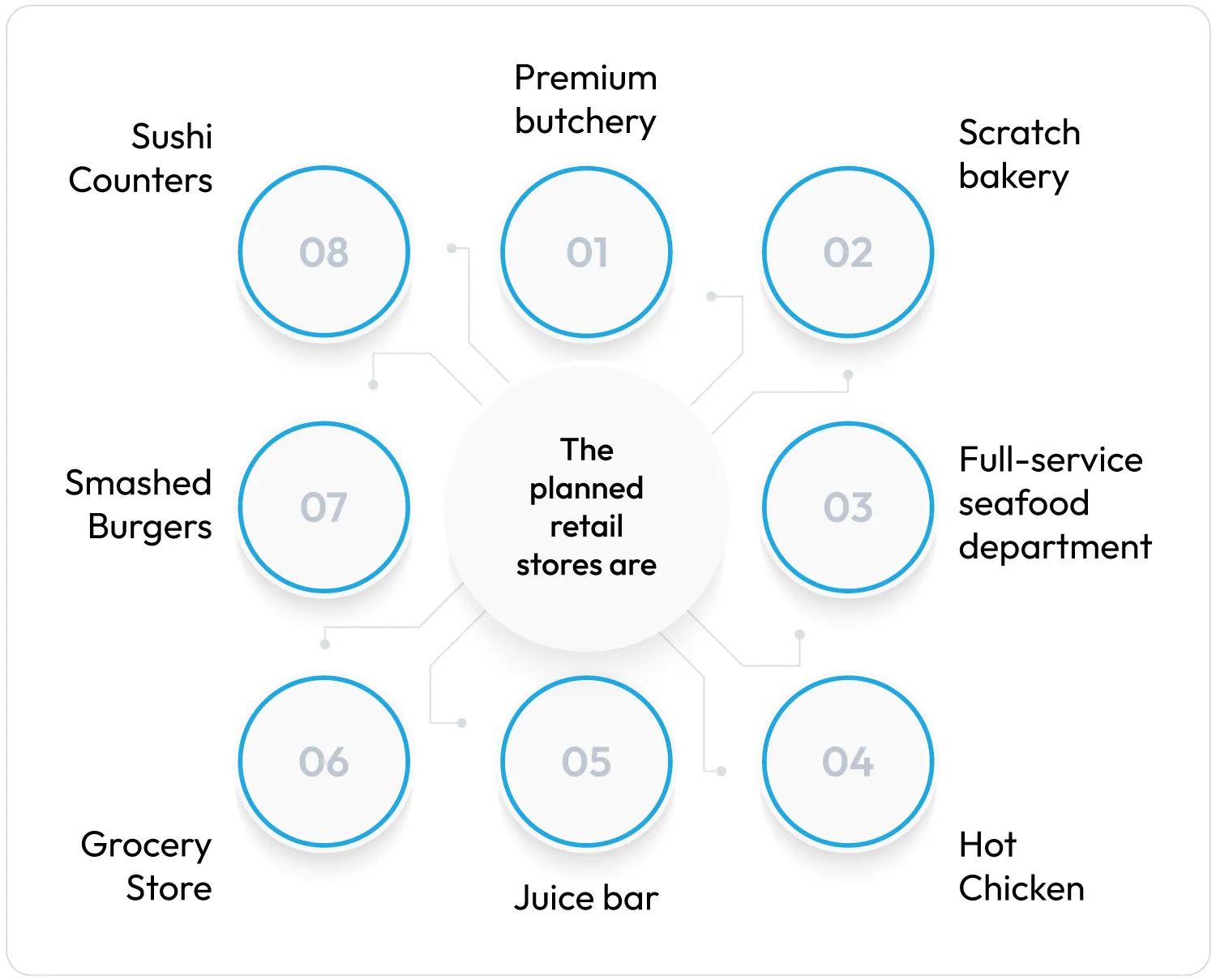
Sandown Store: The major retail investment announced by Food Lover’s Market of R80 million to open a 6500 square metres shopping destination in 2025 hit national headlines for the retail industry. It features Food Lover’s Market’s own 5500 square meter space, and the rest is shared among Market Liquors, Seattle Coffee Co. and VetsMart.
This raises the bar for the retail industry in South Africa. A privately owned retail house investing R80 million sets a new benchmark. The Sandown retail shopping destination will have 14 departments under one roof.
South Africa’s retail trade has been on a steady upswing. Reuters cites recorded retail sales growth of 4.2% year-on-year in January 2026 alone. The biggest categories include grocery and food retail in the growth. For a large and organized grocery retailer like Food Lover’s Market, that’s an opportunity to grow.
Food Lover’s Market’s investment in large retail formats and opening the Sandown Retail Crossing in Cape Town is a testament to the fact that the retail industry is a lucrative one in 2026 and beyond. To use the opportunity to their advantage, retail giants like Food Lover’s Market or Cape Union Mart go for bigger retail formats.
The group prefers opening five or six new stores a year, choosing sites carefully rather than expanding purely for store count.
Did you Know? In late 2025, the Food Lover's Market group opened stores in Zimbabwe's Greendale and in Knysna, and revamped existing stores in Oudtshoorn, Springfield, George, and Brackenfell. Tzaneen, Longbeach, Bassonia, and Ottery followed soon after, alongside a new flagship, River Quarter, on Bottelary Road in Brackenfell.
Source:Supermarket.co.za
This is worth noting for other retailers. Food Lover’s Market’s answer has been to grow in phases, not leaps.
From Supermarket to “One-Stop” Shopping Destination
Notice a pattern?
Sandown isn’t a Food Lover’s Market on its own. It’s a Food Lover’s Market plus a bottle store, a vet and pet shop, and a coffee bar, all under one roof.
The format isn’t new.
The group tested it first at Cornubia, near Durban, in November 2024, its first “Food Lover’s Village.”
The R60 million Cornubia store paired a 2,800m² Food Lover’s Market with Market Liquors, VetsMart, Seattle Coffee Co, and meat brand Eskort. It even added animatronics and digital screens, and a dedicated braai-supplies corner.
The effect was natural. Grocery shopping felt like an outing rather than a chore.
The format works because South African shoppers are increasingly time-poor. One stop for groceries, a bottle of wine, pet food, and a coffee saves a second and third trip elsewhere.
For a family business competing against JSE-listed giants, giving shoppers fewer reasons to leave is a real competitive advantage.
Food Lover’s Market Is Building More Than Stores
1. Local Hirings
At Sandown, 220 colleagues were hired, most of them locally from Parklands, Dunoon, and Atlantis. Sixteen-year company veteran Leo Pan runs the store.
2. Sustainability Focus
Sustainability gets equal importance. Operationally, for Sandown, solar power accounts for approximately 33% of total consumption, alongside the universal deployment of LED lighting and energy-efficient refrigeration.
3. Community Approach
Food Lover’s Market runs the Seeds of Change programme, which buys from small, local food producers and gives them shelf placement to drive shared community value.
Every new store is expected to carry the same commitments to local hiring, local sourcing, and lower energy use, regardless of the province it opens in.
Where Food Lover’s Market Stands on Price
Bigger stores and more departments count for little if shoppers feel priced out. This is where Food Lover’s Market has quietly built an advantage.
A price comparison of nine grocery staples in South Africa published by the Daily Investor on 6th September 2026 shows the prices of a basket containing similar items at various retail supermarkets.
Common Items: bread, oil, mielie meal, sugar, milk, rice, flour, soap, and toilet paper.
Food Lover’s Market’s basket at R413.38 is cheaper than Spar, Shoprite, Woolworths, Checkers, and Pick n Pay, and only R36.98 more than Makro’s basket, the cheapest in the survey.
| Store | Basket Price |
|---|---|
|
Makro |
R376.40 |
|
Food Lover’s Market |
R413.38 |
|
Spar |
R415.91 |
|
Shoprite |
R420.00 |
|
Woolworths |
R435.91 |
|
Checkers |
R439.91 |
|
Pick n Pay |
R455.91 |
Why Local Markets Matter to Food Lover’s Expansion
Ask why the brand grows the way it does, and the community part comes up.
Food Lover’s Market’s every new store commits to local hiring. That’s a deliberate contrast to how many listed chains expand. Food Lover’s Market at Cornubia leans into a Durban-specific Indian spice department, while Sandown showcases premium local pantry brands.
This local-first approach strengthens supplier relationships too.
The Seeds of Change programme sources from small producers who’d struggle to get shelf space with bigger chains.
It’s a model that works well in a country where “local is lekker” isn’t just a marketing phrase, but a genuine consumer preference, especially for fresh produce.
For independent and regional retailers watching Food Lover’s Market’s expansion, the lesson is clear: you don’t need Shoprite’s scale to compete, but you do need a reason for your community to choose you specifically.
The Operational Challenge Behind Food Lover’s Expansion
Managing 14 distinct departments across more than 120 locations creates complex operational vulnerabilities characterized by fragmented inventory visibility.
From the butcher counter to the sushi bar, each department operates on distinct supply chains. Scaling this complexity is an operational challenge in itself.
Across the South African retail landscape, enterprises of all scales have the same challenges and structural headwinds.
Shrinkage and retail theft present a severe drain on profitability. Then come load shedding effects, expiry-related losses, SARS compliance-related penalties, and complexities of multi-department, multi-store operations.
This is where centralized systems fit perfectly. They help multi-format, multi-store retailers to scale seamlessly. A store, irrespective of its geographical location, gets the same ERP system that provides visibility into stock, sales, and supplier performance.
The Technology Backbone Behind Food Lover’s Multi-Store Growth
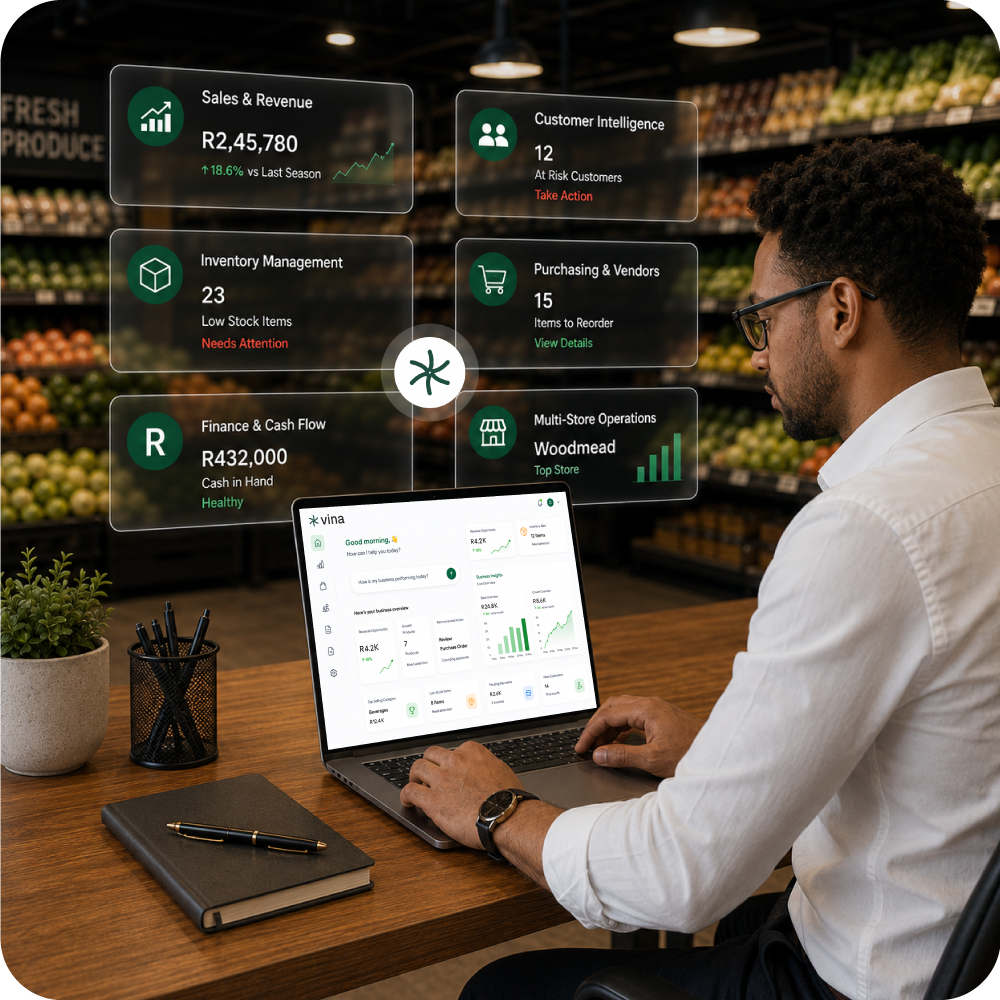
Food Lover’s Market hasn’t published details of its internal retail systems, but its expansion pattern tells its own story. You go to their stores, and you will find POS software taking care of billing. The stocks are not managed manually either.
For retailers without Food Lover’s Market’s three-decade head start, the fastest way to build that backbone is a multi-store POS system built for the same complexity.
It provides real-time inventory status across departments and branches, tells which SKUs sell more or less, and provides insights to restock smartly.
Other features include supplier and purchase management for local sourcing, expiry and batch tracking for fresh departments, and VAT-ready billing for SARS compliance.
Vasy’s supermarket and multi-store retail software is built around this exact problem. It centralises inventory across branches so a stock transfer between stores takes minutes. It supports multi-UOM tracking for products bought in bulk and sold individually.
This hybrid POS architecture ensures operational resilience during load shedding and internet connectivity disruptions.
While these digital capabilities do not replace the community-centric sourcing and store design driving Food Lover’s Market’s expansion, they provide the critical business management features necessary to manage operational complexity at such scale.
What South African Retailers Can Learn From Food Lover’s Market
Food Lover’s Market’s evolution from a single retail stall to a network of 120+ stores over 33 years demonstrates a playbook of a few repeatable high-impact decisions.
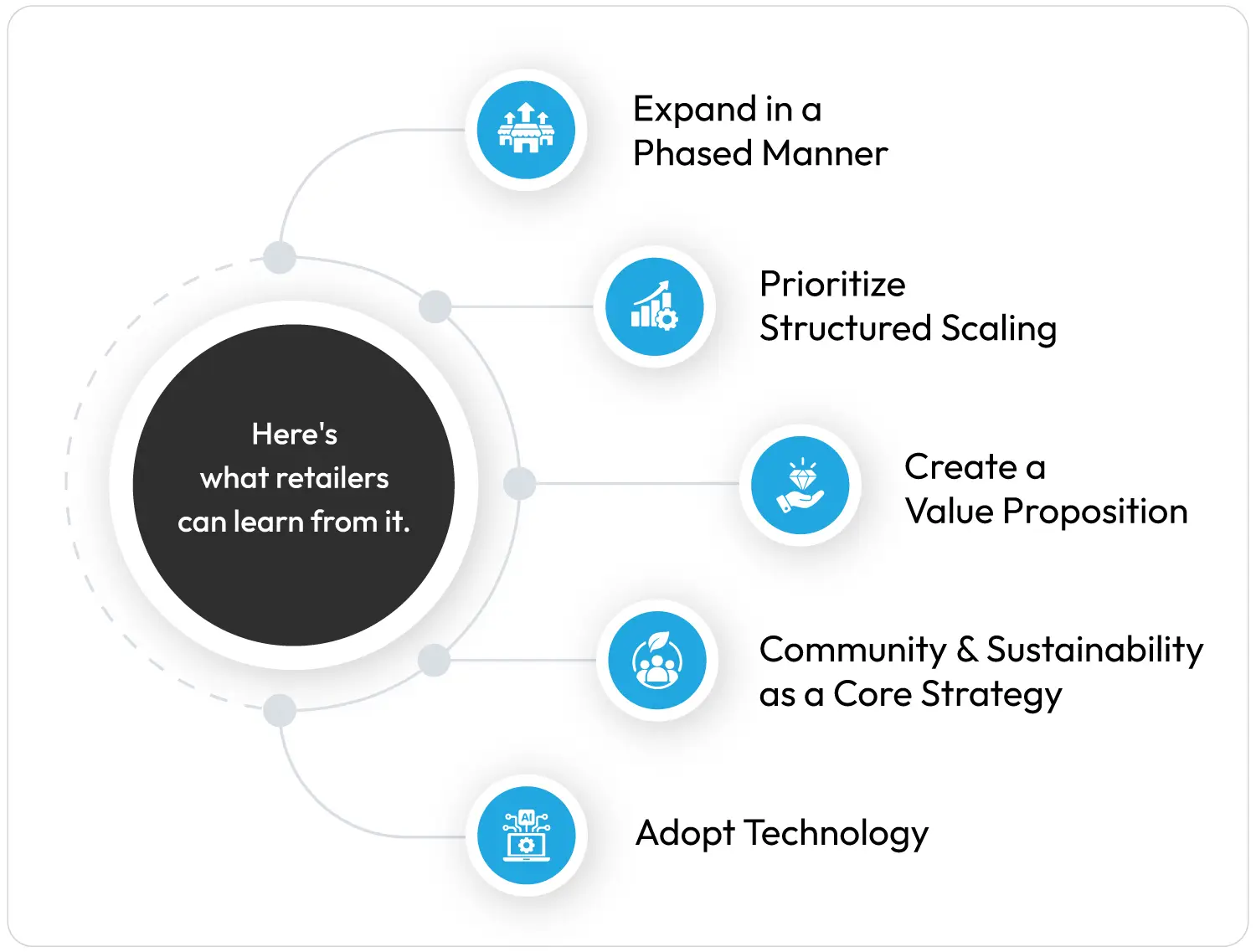
Here’s what retailers can learn from it.
1. Expand in a Phased Manner
For five years, Food Lover’s Market maintained a strict strategic focus on its core fresh produce category. Before executing a multi-department expansion. In contrast, retailers pursuing rapid diversification often disrupt their operating models.
2. Prioritize Structured Scaling
For three decades, Food Lover’s Market has sustained growth by strictly limiting new openings to five to six high-conviction locations per year. Uncontrolled, rapid scaling is not the way to go.
3. Create a Value Proposition
Curated experiential offerings, price advantage, and local sourcing are key value propositions that Food Lover’s Market created for scaling at this level.
4. Community and Sustainability as a Core Strategy
For Food Lover’s Market, localized hiring, solar energy infrastructure, and supplier development initiatives like the Seeds of Change program are pillars of the core growth strategy.
5. Adopt Technology
Scaling multi-site, multi-category retail operations exponentially requires the right technology. AI-powered business management software is something that helps reduce the complexities during retail expansions.
Final Takeaway
Food Lover’s Market’s expansion isn’t a lucky growth spurt. It’s three decades of disciplined, community-rooted decisions, one department, one store, and one province at a time.
For South African retailers watching this growth, the real lesson isn’t the R80 million store or the 14 departments.
It’s the systems, patience, and local focus behind them.
Whether you’re running one store or planning your fifth, Vasy’s retail software for South Africa can give you the same operational visibility that has supported Food Lover’s Market’s growth, without needing three decades to build it. Its AI intelligence layer is built to help small retail stores expand quickly.
Book a free demo to see how Vasy can scale your retail business.
Last Updated on September 8, 2026