Quick Summary:
Supermarket businesses take considerable investment, and therefore, it requires a well-planned execution to start your supermarket in SA. From registration and obtaining the key licences to setting up billing counters and stocking the right products, this guide details everything you need to open a supermarket in South Africa without hassle.
This article will help you understand:
- How to register a supermarket and which licences and documents you need.
- The current compliance, labour, and tax rules that apply in 2026.
- How to determine its location, layout, and product assortments.
- Which software and customer-experience technology modern supermarkets need.
Opening a supermarket in South Africa needs a clear step-by-step plan and strategic approach. While supermarkets are lucrative businesses, they are also highly competitive. Many supermarket chains operate in SA, and therefore, you need differentiators to run your supermarket profitably and beat competition. Retail technology such as supermarket software can help you create that competitive advantage. But before that, you need to open it the right way.
This guide is a comprehensive answer to opening a supermarket in South Africa the right way. From the registration process and location analysis to suppliers and inventory control, this guide covers everything that comes under starting a supermarket in South Africa.
Is Opening a Supermarket in South Africa Still a Good Idea in 2026?
Giants like Shoprite, Boxer, Pick n Pay, SPAR, and Woolworths are already in the market. Compliance is strict, as supermarkets sell food items too. And customers now expect fast checkouts, fresh product assortments, affordable basket prices, discounts, and better shopping experiences.
Yes, if you plan to open a supermarket in SA, also plan for value, availability, and efficiency from day one.
Rest, the market is fine, and no matter what happens, South Africans go to supermarkets to buy groceries. The numbers support the opportunity.
- Retail trade sales rose by 3.4% year-on-year in July 2026.
- Shoprite Holdings grew sales by 7.2% to R270.8 billion in its 2026 financial year.
- Discount grocer Boxer opened 51 new stores.
- Cape Union Mart is opening a 2500 square metre store in Gqeberha.
- Food Lover’s Market is expanding its retail footprint with 120+ stores across SA.
So, yes, the market offers great opportunities for supermarket businesses.
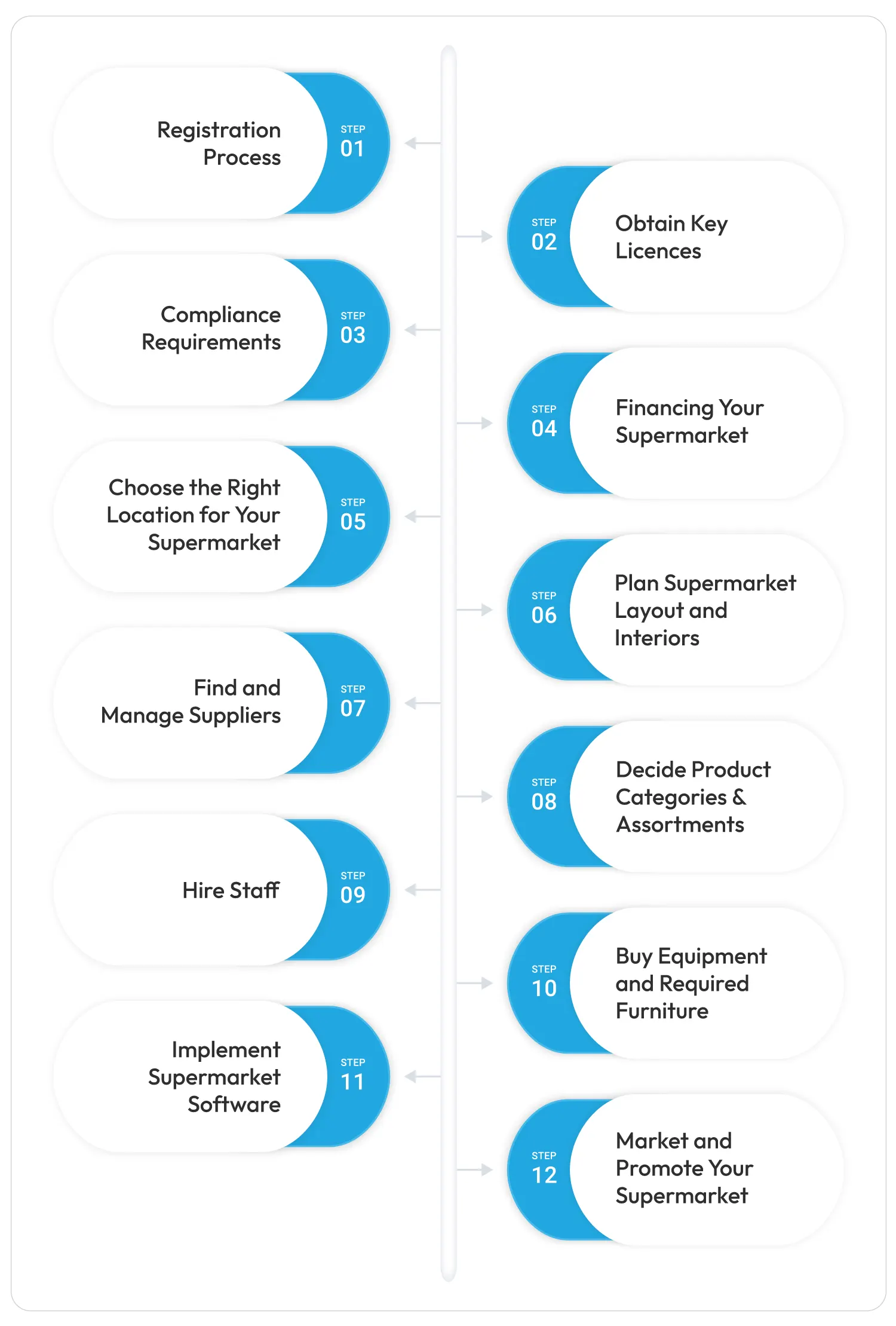
Step-by-Step Process of Opening a Supermarket in South Africa
Step 1: Registration Process
You register a supermarket in five steps: choose a structure, register with CIPC, register for income tax and VAT, register as an employer, and open a business bank account.
- Choose your business structure: Most supermarket owners need a private company (Pty) Ltd. It separates your personal assets from business debts. A sole proprietorship is also allowed, but then you carry all the liability. It is also easier to get funds if you register a private company.
- Reserve a name and register with CIPC: The Companies and Intellectual Property Commission (CIPC) has an online portal through which name approval and registration can be done. You will receive a registration certificate and company number.
- Register with SARS for VAT: A newly registered company is usually linked to an income tax number automatically. Check it on SARS eFiling. From April 2026, the threshold for VAT is R2.3 million in revenues in any 12 months. Supermarkets generally cross this revenue mark even in their first year of opening.
- Register as an employer: Register for PAYE, UIF and SDL with SARS. Register your staff for UIF with the Department of Employment and Labour. Register with the Compensation Fund for COIDA cover.
- Open a business bank account: You need to open a bank account to keep your supermarket finances separate from personal ones.
Did you Know The compulsory VAT threshold had stayed at R1 million since 2009. The 2026 Budget more than doubled it to R2.3 million, while the voluntary threshold rose to R120,000 in April 2026.
Source:SARS
Pro Tip: Supermarkets pay VAT on shop fittings, equipment and many standard-rated stock lines. As a vendor, you can claim that input VAT back.
Step 2: Obtain Key Licences
The two licences every supermarket needs before trading are a municipal business licence and a Certificate of Acceptability (COA). Other permits depend on what you sell and where you trade.
- Municipal Business Licence: Under the Businesses Act 71 of 1991, selling perishable foodstuffs requires a business licence from your local municipality.
- Certificate of Acceptability: The COA is issued under Regulation R638 of 2018, the national hygiene regulation for food premises. Trading without a valid COA is a criminal offence.
Other key licences required are:
| Document/License Required | Issuing Authority | Why You Need It? |
|---|---|---|
|
Company registration certificate |
CIPC |
Proof that your business legally exists |
|
Income tax and VAT registration |
SARS |
Tax compliance and VAT invoicing |
|
Certificate of Acceptability |
Municipal Environmental Health |
Confirms your premises meet R638 hygiene rules |
|
Zoning / land-use approval |
Municipal town planning |
Confirms the site may be used for retail |
|
Approved building plans and occupancy certificate |
Municipality |
Needed for new builds or major alterations |
|
Fire compliance certificate |
Municipal fire department |
Fire safety of the building, exits, and equipment |
|
Registered electrician |
Safe wiring for refrigeration and tills |
|
|
Liquor licence (if selling alcohol) |
Provincial liquor authority |
Required to sell wine, beer, or spirits |
|
Signage approval |
Municipality |
Outdoor signs and billboards |
|
Signed lease agreement |
Landlord |
Proof of right to occupy the premises |
Step 3: Compliance Requirements
Licences get you open. Ongoing compliance keeps you open. Supermarkets in South Africa must follow food safety, consumer, data, trade metrology, tax and labour laws every single day.
- Food safety (R638): Appoint a trained Person in charge. Train every food handler. Keep temperature logs, cleaning schedules, pest control records and product traceability records on site.
- Food labelling: Every product you sell must follow a proper labelling process and adhere to food labelling rules.
- Consumer Protection Act (CPA): Display clear shelf prices. Charge the lowest displayed price if labels conflict. Honour the customers’ right to return defective goods.
- POPIA: If you run a loyalty programme or collect phone numbers, you must get consent, secure the data, and appoint an Information Officer.
- Legal Metrology Act: Scales that you deploy in the supermarket must be approved by the authority. Weight-based goods scales must be approved and verified by the National Regulator for Compulsory Specifications (NRCS).
- Labour law: Follow the Labour Relations Act and other mandatory labour laws of SA.
Government Policy Update: From 1 March 2026, the national minimum wage rose from R28.79 to R30.23 per hour.
Source:SARS
Step 4: Financing Your Supermarket
You need to plan for financing your supermarket venture. Plan for shop fitting, refrigeration, POS hardware and software, three months’ salaries, security, marketing, licences, and a cash buffer of at least three months’ operating costs.
Most supermarket owners combine two or three funding sources:
- Your own capital
- Bank finance
- Government or development finance loans
- Franchise groups
- Commercial Banks
Step 5: Choose the Right Location for Your Supermarket
Location analysis is important to ensure footfall. Most supermarkets do a location analysis before fixing the location.
Below is the guideline to conduct the catchment study:
- Population and income profile: Map the households within a 5–10 minute walk or drive. Match your store format to local spending power. This helps decide whether you should open in township sites or suburban malls.
- Local Competition: Count the supermarkets that have stores nearby. A gap in location is necessary for a successful business and to ensure retail footfall.
- Foot traffic and transport: Taxi availability, bus stops, schools, and apartments nearby create steady daily traffic.
- Access and parking: You receive goods from delivery trucks that need proper parking space, and shoppers and your staff also need proper parking space.
- Utilities and safety: Check the area’s power reliability, water supply, and crime levels.
- Rent: Check the rental prices in the area. Too high prices will lower your margin.
Step 6: Plan Supermarket Layout and Interiors
A good layout means easy movement inside the store, all aisles wide enough for hassle-free shopping, parallel aisles, and great ambience.
Plan for:
- Trolley zones
- Fresh Produce zones
- Categories-wise aisle
- Centre aisles
- Billing counter
- Staff rest rooms
- Shopper rest rooms
- Storage area
- Cold storage area
Plan all categories logically with a focus on improving accessibility.
For interiors, choose bright LED lighting, slip-resistant flooring, and clear hanging signage by category.
Pro Tip: Use planograms for every aisle. A planogram shows exactly where each SKU is placed on the shelf. When it is linked to your inventory data, staff know what to refill and where.
Step 7: Find and Manage Suppliers
Suppliers for replenishment of your daily inventory, core inventory, and fresh produce are key to keeping your supermarket running smoothly without stockout issues. A proper supplier-to-product mapping also helps in saving costs.
Create a list of top suppliers for all categories that you have decided to sell. You can negotiate with them on pricing, terms, delivery costs, timelines, payment schedules, and quality.
Also, fix return policies for damaged and expired goods.
A new supermarket usually buys from four types of suppliers:
- FMCG manufacturers and their distributors
- Wholesalers
- Distributors
- Local farmers and fresh-market agents
Step 8: Decide Product Categories/Assortments
Diverse product categories and assortments with all product variants are key to shopper satisfaction and increasing revenue. Below are common product categories that you should stock before commencing your supermarket.
|
Fresh produce
|
Bakery
|
Butchery and deli
|
|
Staples and dry grocery
|
Beverages
|
Household and cleaning
|
|
Dairy and chilled
|
Frozen
|
Services
|
|
Personal care and baby
|
Breakfast and spreads
|
Snacks and confectionery
|
Pro Tip: Follow the 80/20 rule. Around 20% of your SKUs will drive most of your sales. Track them weekly and never let them go out of stock. Deploy the best practices for inventory management.
Step 9: Hire Staff
People are your highest cost after stock, and they are important too. You need staff for billing and stock management. The exact staff numbers depend on your store size. A small neighbourhood supermarket may start with less than 10 people. A large store with a butchery and bakery can need 30+ employees.
- Store manager
- Assistant/department managers
- Cashiers and till supervisors
- Merchandisers/shelf packers
- Butchers, bakers and deli staff
- Security guards
- Cleaners
Training checklist for new staff:
- R638 food safety training
- Hygiene training
- POS billing training for cashier
- Complaint handling
- Ethics
- Health and safety
- Fire drills
- Age-restricted sales rules
- Stock handling
- Expired goods dealing
Step 10: Buy Equipment and Required Furniture
You need daily equipment and proper furniture to start your supermarket. Below are the key equipment, cleaning supplies, and furniture you need to start with:
|
|
Step 11: Implement Supermarket Software
A modern supermarket cannot run efficiently with manual processes for billing, stock handling, reporting, promotions, customer relationships, financials, etc. You need to implement smart supermarket software that takes care of all these operational activities. With AI-powered supermarket software, you can record all activities digitally and automate many of them.
Implement supermarket software that has the following modules or solutions built-in:
1. POS (Point of Sale)
A POS system that handles billing with barcode scanning, weigh-scale integration, and creates VAT-compliant invoices. It must also have multiple payment methods and the ability to manage loyalty points, discounts, etc. It must also come with offline billing capabilities during load shedding or internet disruptions.
2. Inventory Management
Inventory management software will ease the work of your staff in tracking thousands of SKUs across the shelf and warehouse. It must also have features for expiry management, barcode label generation, low-stock alerts, stock verification, etc.
3. Accounting
Accounting software should reconcile sales and purchase data directly from your POS into the account books. It should prepare VAT returns, supplier ledgers, and profit reports.
4. CRM
A retail CRM is built for helping you retain your customers. From running loyalty programmes to sending targeted WhatsApp or SMS offers, a supermarket software with a CRM module is what you need for improving customer relationships.
5. Smart Features
- Self-Service Kiosks and Self-Checkouts that let shoppers with small baskets skip the queue and do automated checkouts themselves.
- Smart Carts built with a tablet that helps scan products and bill themselves.
- Customer-Facing Displays (CFDs) are the second screen at the till behind the cashiers where customers can see the cashier’s screen on big displays. It builds trust and reduces billing disputes.
6. Business Intelligence Reporting
You need an AI-powered supermarket software capable of tracking and reporting KPIs weekly, daily, hourly, and in real-time as required:
- Sales by department and hour
- Average basket value
- Gross margin % by category
- Stockout rate
- Shrinkage %
- Stock turn/inventory turnover
- Waste and expiry value
- Fast- and slow-moving SKUs
- Supplier fill rate
Step 12: Market and Promote Your Supermarket
Supermarket marketing has one job: bring shoppers in for the first time, then give them reasons to return every week.
Promotion ideas that work for South African supermarkets:
- Grand opening week: Provide deep discounts, create an event, call a local DJ.
- Coupons: Create coupons, bundles, discount offers, and more.
- Local marketing: Hire a local marketing agency to market your supermarket locally.
- Loyalty rewards: Always let your shoppers know that with every purchase they get redeemable cashback points.
- WhatsApp messages: Promote your supermarket on WhatsApp, send offers, promotions, new arrivals, etc.
- Google Business Profile: Create a GMB profile and put your supermarket’s images and other relevant info.
- Community ties: Sponsor school events, local football clubs, and church functions.
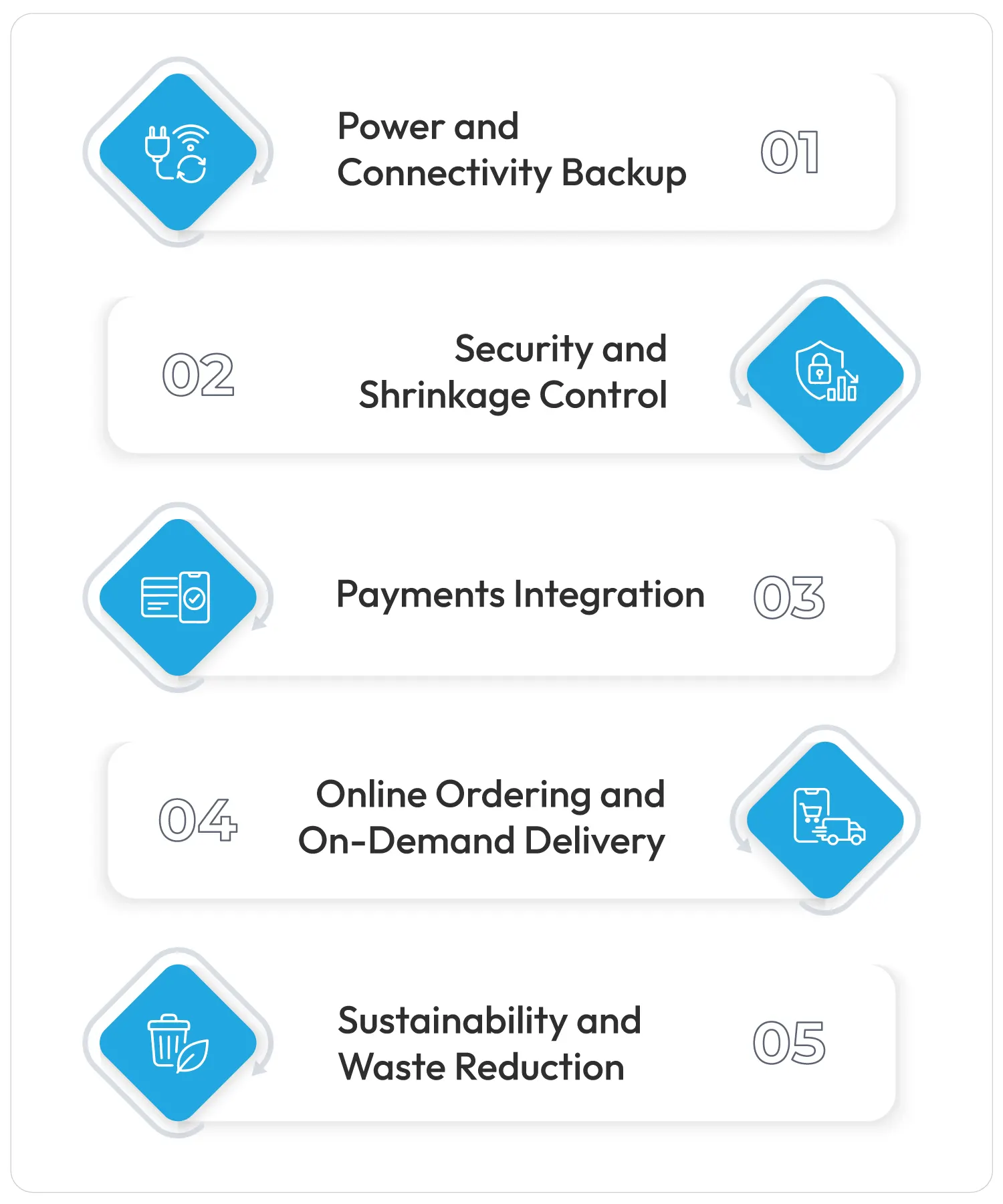
5 More Key Factors to Plan Before Opening Day
The basics get your doors open. These five factors decide whether your supermarket stays resilient and competitive.
1. Power and Connectivity Backup
Load shedding still affects some high-risk areas, and internet outages happen in South Africa even in 2026. Keep a generator or inverter ready for billing tills to run even during power cuts. Or deploy a POS that bills offline and an mPOS that can be used to set up billing counters during power cuts.
2. Security and Shrinkage Control
South African retail loses an estimated R23 billion a year to crime and shrinkage. Protect your store with CCTV installed over all areas, especially at cash counters and high-value inventory aisles and storerooms.
3. Payments Integration
You need to ensure payment integrations to accept cards, tap-to-pay, QR codes, and EFT alongside cash.
4. Online Ordering and On-Demand Delivery
Shoppers now expect to order groceries online. You can use an omnichannel POS system to take your supermarket online. Let your customers buy from your own custom e-store.
5. Sustainability and Waste Reduction
Waste reduction measures such as expiry management alerts with POS software and surplus stock management are a few measures you need to take for sustainable growth and waste reduction. Also, choose energy-efficient refrigeration and LED lighting, and consider rooftop solar to cut your electricity bill.
Conclusion
Opening a supermarket in South Africa need not be a hassle. Therefore, follow our guide and its step-by-step process for a well-planned and strategic approach to opening your supermarket in South Africa.
Once you open it, you can scale to multiple outlets with the implementation of smart supermarket POS software such as Vasy. It also comes with an inbuilt AI layer that answers your queries in real time and acts as your personal business operator.
For more details, connect with the Vasy Team now.
Last Updated on October 5, 2026