Quick Summary:
Want to open your first liquor store in South Africa? Know the process, licensing, and zoning requirements with our simple 2026 guide on how to start a liquor store in South Africa. From the documents required to product assortments and promotions, this guide details all that you need to open a liquor store without hassle.
This article will help you understand:
- How to register a liquor store in South Africa.
- What licenses and compliance adherence you need.
- How liquor store software helps operate the retail store.
Liquor stores are one of those perennial retail businesses that run the whole year. The business is also predictable and doesn’t get affected by seasonality. In fact, sales are even higher during festivities. Even in tight economic conditions, sales don’t get affected much.
A retail liquor store is a lucrative business, and if you are planning to start one in South Africa, you need to follow a proper process. You need proper registration, licenses, and permits to run a liquor store. To manage liquor store billing, inventory, customers, suppliers, and finances, you need liquor store software.
This guide explains how to start a liquor store in South Africa and keep it operational profitably.
Is Opening a Liquor Store in South Africa a Profitable Business Idea in 2026?
The liquor store business is a high-margin and high-turnover retail segment. The products have high and consistent demand. In fact, if you see the success stories of other liquor retailers and the numbers of the South African liquor retail industry, you know that it is a lucrative business.
- South Africa’s liquor market is worth R109 billion.
- Checkers LiquorShop grew sales by 14.5% in H1 2026.
- The Shoprite Group opened 93 new liquor stores in South Africa in a single financial year. (12 months ended 28 June 2026).
- The beer market in South Africa alone is at USD 3.5 billion. It is further expected to reach 6.0 billion by 2030 at a 6.7% CAGR.
Even grocery businesses are racing to open new liquor stores owing to the high margins the liquor segment offers. So, your idea of starting a liquor store is good to go.
Types of Liquor Stores in South Africa
In South Africa, you will find different types of liquor stores. So, before you want to register, you need to know the types. The store type decides your license fees, category, stock requirements, and also the investment.
| Store Type | Selling Stocks | License Required | Suitable for |
|---|---|---|---|
|
Standalone bottle store |
Beer, cider, wine, spirits, RTDs, mixers |
Off-consumption (liquor store) licence |
Independent owners in suburbs, towns and townships |
|
Grocery-linked liquor store |
Full liquor range beside a supermarket |
Off-consumption licence for a separate premises |
Supermarket owners who want a second revenue stream |
|
Wine and craft boutique |
Fine wine, craft beer, craft gin, premium spirits |
Off-consumption licence |
Tourist areas, wine routes |
|
Online liquor store |
Delivery from a licensed premises |
Off-consumption licence for the dispatch premises |
Urban areas with high app and delivery usage |
Step-by-Step Process of Starting a Liquor Store in South Africa
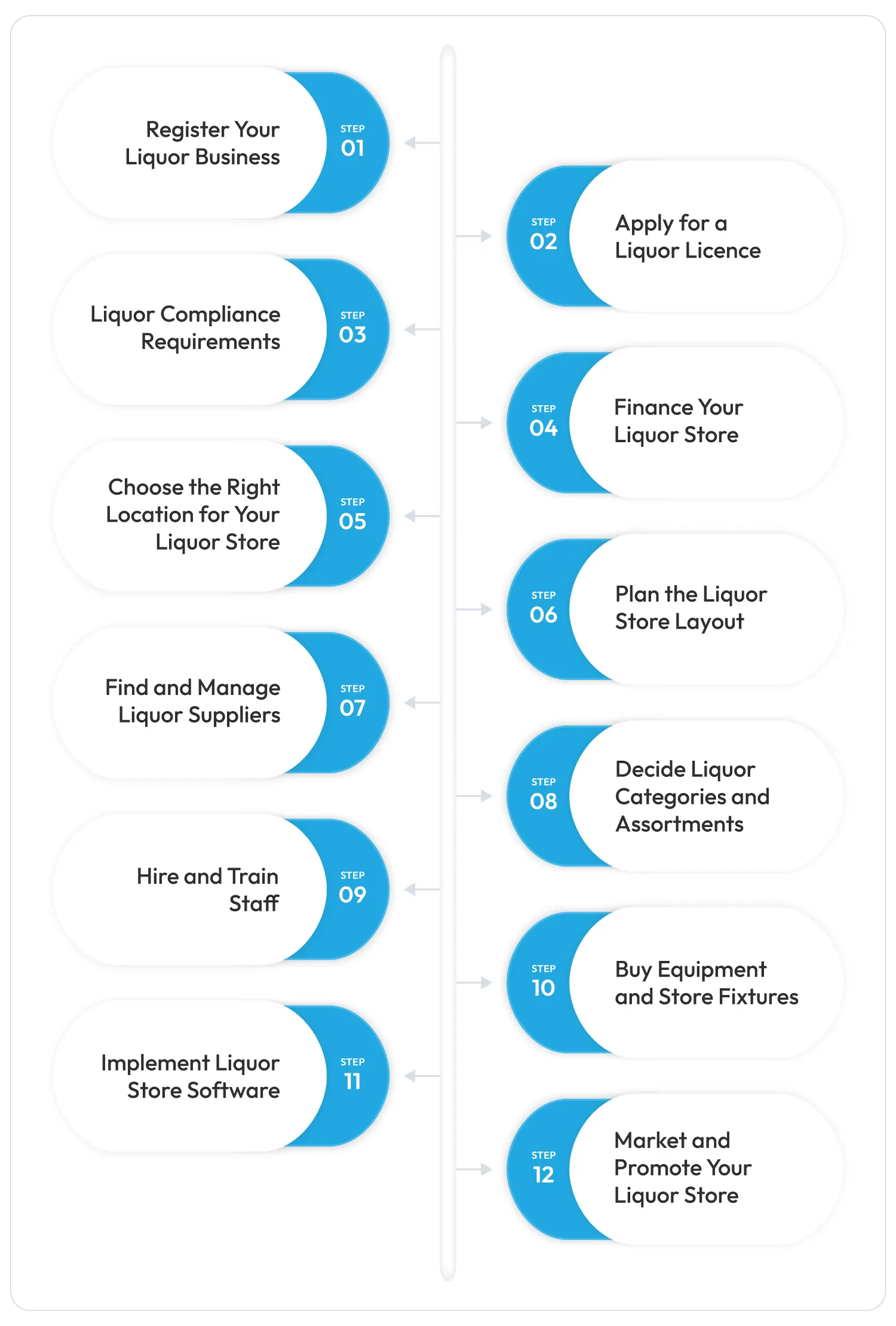
Step 1: Register Your Liquor Business
You register a liquor store in five steps:
- Choose your business structure: Most liquor store owners need to register the business with the National Liquor Authority of South Africa.
- Register with CIPC: Reserve your liquor store name and register online. You will receive a registration certificate. The liquor board asks for these documents.
- Register with SARS for VAT: The compulsory VAT threshold is R2.3 million in taxable sales over 12 months. A busy liquor store crosses the revenue mark easily. So, register with SARS for a VAT number.
- Open a business bank account: You will need it for financial transactions. You cannot take liquor sales money directly to your personal account.
Step 2: Apply for a Liquor Licence
The liquor licence is the key document to open and operate a liquor store with permission from the SA government. The National Liquor Act 59 of 2003 requires retail liquor stores to obey the provincial laws. Therefore, you need to apply to the provincial liquor authority.
For instance, to register a liquor shop in Western Cape Town, you need to register with the Western Cape Liquor Authority.
The liquor licence process usually follows these steps:
1. Secure the premises and zoning: Get a zoning certificate or consent use from your municipality. Some zoning requirements include that your shop must not be in the vicinity of a school or places of worship.
2. Prepare the documents:
- Application form
- Photographs of the premises
- CIPC registration
- SAPS certificate or clearance
- Proof of tax compliance.
3. Submit application and pay the fees: Submit the application to the Liquor Board.
4. Public objections: Residents, ward structures, and community groups have the right to object to the applications. You then get 7 days to respond.
5. Inspection and police report: Liquor inspectors and SAPS check the premises.
6. Decision and hearing: The liquor board then grants or refuses the licence.
Timeline: The liquor licence approval timeline varies by province, but it usually takes between 4 to 6 months.
Step 3: Liquor Compliance Requirements
The licence is the main certificate that allows you to operate a liquor store in South Africa. However, you need to adhere to certain regular compliance requirements. Liquor boards keep inspecting the premises and stores and retain the right to suspend or cancel a licence for repeated breaches.
- No sales to minors: Never sell liquor to anyone under 18. Ask for ID whenever a customer looks young.
- No sales to intoxicated customers: Law requires you to refuse liquor to anyone who is visibly drunk.
- Trading hours: Local municipal laws are different for each region in South Africa. Your opening and closing hours are determined by local municipal laws. Many areas restrict late-night sales.
- Licence renewal: You need to renew your licence every year. For instance, in the Western Cape, renewals are due by 31 December.
- Licensed supply only: You have to sell retail liquor bottles procured from registered manufacturers and distributors only.
Step 4: Finance Your Liquor Store
You can get the location, premises, shop, certificate, and license too. You then need stock from suppliers. However, all these will require investment. Liquor businesses need substantial cash investments. Stocking premium whisky and wine needs capital.
You need to set a budget for registration, license, rent of the shop, staff, stock, and electronics such as beverage refrigerators. You also need some display furniture. Other requirements such as cameras, safes, billing software, etc. will also need to be budgeted properly.
Most owners combine two or three funding sources:
- Own capital or partner investment
- Commercial bank loans
- Supplier credit from distributors
- Franchise brand support
Step 5: Choose the Right Location for Your Liquor Store
For a liquor store, footfalls are the main source of revenue. Also, it should pass the liquor board’s inspection criteria.
Use this checklist for your location study:
- Distance rules: Choose a location where there are no schools, places of worship, and public transport facilities within 1km.
- Zoning: Confirm the site is zoned for commercial use and should not strictly be a residential zone.
- Community acceptance: Learn about the community and their objections to previous liquor stores in that area. You can talk to a ward councillor. Community objections can cause the liquor board to reject your license.
- Outlet density: While this is a sign that the location is approved by the authorities and the community, it can hamper sales due to market saturation. Check the number of liquor stores and opportunities for your store.
- Foot traffic: Shopping centres and busy main roads bring footfall. A spot near a
- Parking and deliveries: Trucks deliver heavy pallets of beer cases. You should have a proper area where you get your stock delivered without access issues.
- Security: Liquor stores are high-risk targets owing to the cash they create on a daily basis. Check the area’s crime levels before you fix the location. High crime areas need higher insurance premiums.
Step 6: Plan the Liquor Store Layout
A good liquor store layout improves space utilisation, makes products easy to display and find, and also keeps the beer cold storage optimal.
Plan for:
- Group the spirits as per their category on shelves (wine, whisky, brandy, vodka, rum, premium spirits, etc.)
- Plan where to keep the cold storage
- Billing counter
- Lockable cabinets for expensive premium liquor bottles
- Pallet and case area
Step 7: Find and Manage Liquor Suppliers
Reliable suppliers are key to regular and unhampered supply of liquor stocks. Choose suppliers based on their name in the industry, terms, supply quality, delivery reliability, and the margins they provide you.
Never engage with illicit stock providers. Not only is it illegal, but if they supply you with spurious liquor or adulterated alcohol, you can also get into big legal trouble.
Also, big brands in liquor such as Diageo also help in promoting your store with displays offered by them.
A new liquor store usually should buy from:
- Wine distributors
- Liquor wholesalers
- Major brewers such as South African Breweries and Heineken Beverages
- Spirits companies such as Diageo and Pernod Ricard
- Spirit companies’ distributors
- Local craft breweries and distilleries
Pro Tip: Map each liquor bottle product to its supplier in your system. Use the supplier-to-product mapping feature of liquor store software to compare and map suppliers and generate purchase orders.
Step 8: Decide Liquor Categories and Assortments
Liquor stores that want to scale fast and be a favourite of liquor connoisseurs need to stock the right inventory. It requires a balanced approach that starts with stocking everyday beers and whiskies to premium ones. It also means that you need house liquor categories from beers and wine to brandy and white spirits.
|
Beers
|
Ciders
|
|
Brandy and Whisky
|
White Spirits
|
|
Wine
|
Mixers
|
Note: While stocking your liquor categories, check for the local trends. For instance, last year, RTD volumes grew 14%. This means you need to stock RTD variations.
Step 9: Hire and Train Staff
Liquor stores are busy places, especially during evening rush hours. You need to hire and train sufficient staff as per the retail traffic your store receives. Depending on your store’s size, you need staff ranging from a store manager to cashiers, handling staff, and counter staff.
Training checklist for new staff:
- Ask your staff to check the age IDs of buyers who look young and are below 18 years of age.
- Train them to refuse sales to visibly intoxicated customers.
- Train them to close in time before the trading hours restrictions set by local municipal authorities.
- Train them to handle returnable bottle and crate deposits.
- Train them to handle attempts at robbery.
- Provide them with basic training regarding SOPs that liquor stores follow.
- Train them to manage customer rush, angry customers, and other issues.
- Train your staff for extensive product knowledge about liquor categories, brands, volumes, signs on bottles, etc.
Step 10: Buy Equipment and Store Fixtures
You need cooling, security, and billing equipment before opening day.
| Cooling & Display | Security | Billing & Operations |
|---|---|---|
|
|
|
Step 11: Implement Liquor Store Software
To manage liquor store billing, inventory, customers, suppliers, and finances, you need liquor store software.
Implement liquor store software that has the following modules or solutions built in:
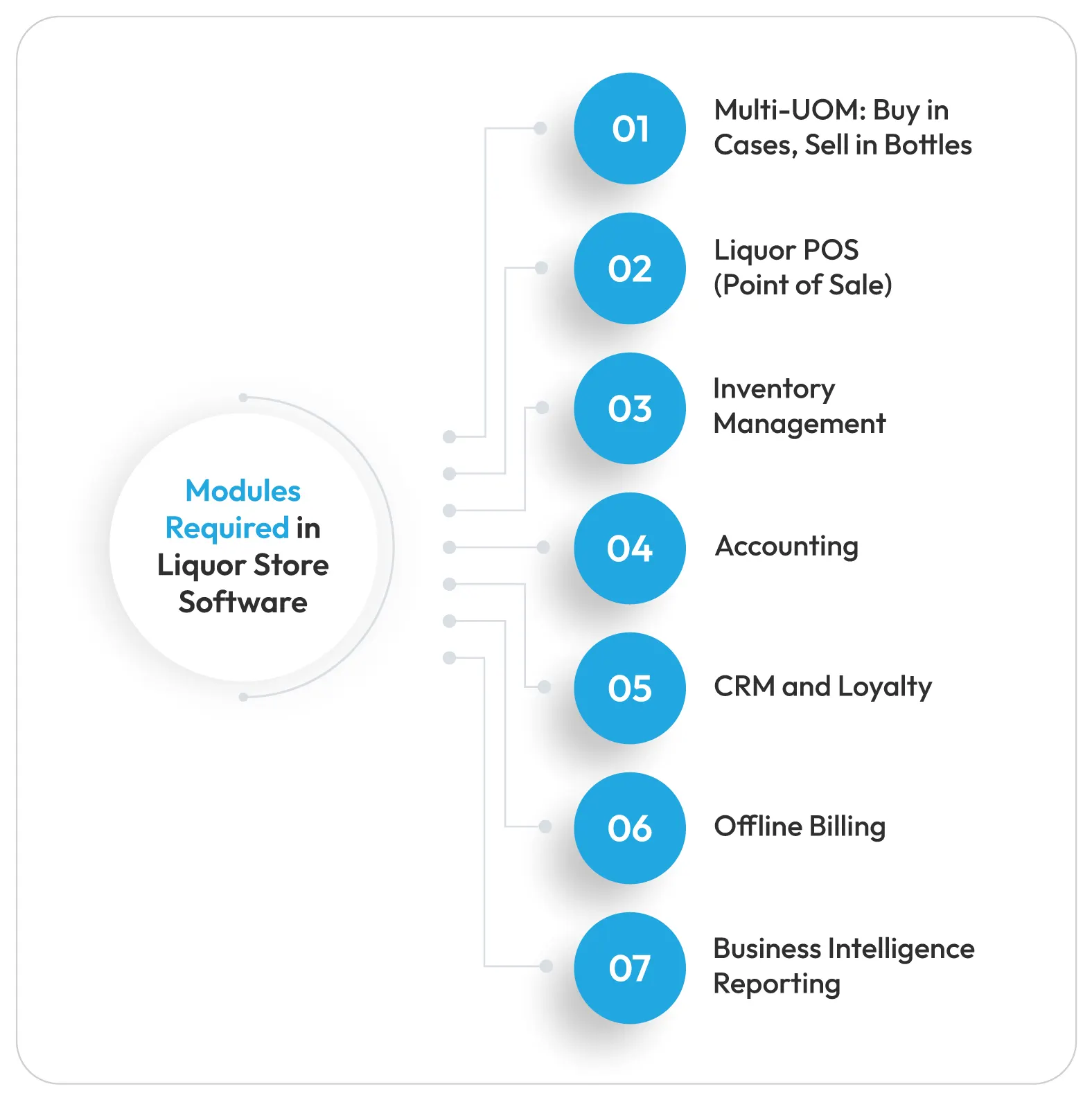
A. Multi-UOM: Buy in Cases, Sell in Bottles
Multi-UOM (multiple units of measure) is the most important feature for a liquor store. Generally, you will procure your liquor supply from distributors and liquor brands in cases, cartons, or pallets. However, most of your retail sales will be in single bottles, cans, etc. A multi-UOM is required to convert the higher units (cases) into smaller units (single bottles) during sales.
Here is how a single beer SKU works with Multi-UOM:
You procured 10 cases of 24 beer cans each. The multi-UOM feature of liquor store software will convert it into 240 individual cans. You can set the price of each can for sale at the POS. Also, you can set separate pricing for a 6-can pack, a 12-can pack, or a 24-can pack. This way, you can set different margins based on the buy volume.
Multi-UOM generates separate barcode labels for singles, packs, and cases. Cashiers no longer count cans at the till. Each sale, return, and transfer updates stock in the base unit. Sell one can from a case, and the system shows 23 cans left, not one broken case.
B. Liquor POS (Point of Sale)
A POS system for a liquor store is required to bill at the counter. Invest in a POS that lets you scan the barcode you have fixed on the liquor bottle. Scan and bill the bottle in seconds. VAT as per the bottle price is auto-calculated. A smart POS with multiple payment integrations will allow you to receive bill amounts from customers in cash, card, EFTs, etc.
C. Inventory Management
Inventory management software lets you categorise all liquor products:
- Categories as per liquor types (beers, whisky, brandy, white spirits, etc.)
- Categories as per brands (Diageo, Pernod Richard, Heineken Beverages, etc.)
- Bottle size variants (50 ml, 200 ml, 375 ml, 750 ml, 1000 ml, 1500 ml, etc.)
It also generates barcodes for them, keeps a record of stock, and directly integrates with POS to update stock records automatically as per sales at the POS. However, this happens only when you have implemented an integrated inventory management system like Vasy. Inventory management software also helps you do stock verification and counting with mobile-based barcode scanning. Also, manage a liquor warehouse with a built-in warehouse management system.
D. Accounting
Accounting software that is integrated into liquor store software, along with POS and inventory modules, does real-time accounting for your liquor store business. It accounts every POS entry directly to the books. It also prepares VAT reports, balance sheets, supplier ledgers, and profit reports for you.
E. CRM and Loyalty
A retail CRM helps you keep regular customers. You can run loyalty points programmes for your regular customers. Send them birthday offers and WhatsApp promotions for customers who have opted in.
F. Offline Billing
Power and internet cuts won’t stop your billing during rush hours with a hybrid POS. South Africa’s top liquor store software providers like Vasy come with offline billing capabilities. It later updates the data to the cloud as soon as internet connectivity resumes.
G. Business Intelligence Reporting
You need AI-powered liquor store software that tracks POS reports in real time:
- Sales by category, hour, and day of the week.
- Sales by unit: singles, packs, and cases.
- Top-selling liquor categories.
- Top-selling liquor brands.
- Top-selling liquor product variant.
- Top-selling liquor bottle size of a brand.
- Slow-moving brands
Implement Vasy: The Best AI-powered Liquor Store Software in South Africa
With Vasy, you get billing, inventory, accounting, CRM, and reporting all run on one cloud platform built for South African liquor retail.
Also, its AI layer, vina, directly answers your queries. Ask vina which bottle brand sold the most during the last 7 days. It will answer directly. You need not generate any report. Get instant answers to grow your liquor store at lightning speed.
Step 12: Market and Promote Your Liquor Store
Liquor marketing must be responsible and avoid displays in public spaces. It should not be promoted to minors, and never encourage excessive drinking. Still, you need something to market your newly opened store.
Promotion ideas that work for South African liquor stores:
- Promotional deals and discounts: Use liquor store software to form promotional deals, combo packs, and discounts.
- Pack and case pricing: Price six-packs and cases lower than single bottles and cans to reward bigger baskets.
- Tasting Event: Host wine tasting events while abiding by local by-laws.
- Loyalty rewards: Give points on every purchase to your customers that they can redeem during the next bottle purchase.
- WhatsApp Messages: Share new arrivals with customers.
- Brand Promotions: Request liquor brands for promotional supplies and display screens.
Conclusion
Starting a liquor store in South Africa takes patience, authority approvals, paperwork, license fees, location, suppliers, and investment. You also need year-round compliance adherence. You also need technology such as liquor store software to handle billing and stock operations.
With liquor store software like Vasy, you can buy in cases, sell in bottles, bill faster with barcode-based billing, and manage your inventory categories like a pro. Its built-in modules for accounting and CRM too makes it a one-stop operational solution for liquor retailers. Its inbuilt AI layer answers your business questions in real time. Vasy’s multi-store management also helps you add new liquor stores within a day.
Last Updated on October 13, 2026